Introduction
A severe weather alert hits at 2 PM on a Saturday afternoon. Your retail stores are full of customers and staff. You need to notify 300 employees across 47 locations about evacuation procedures. But here's the problem: half your workforce started within the last six months, a quarter of your team is working their first shift this week, and your notification system still relies on email and phone trees. By the time your message reaches the right people, the emergency has already arrived. This scenario plays out in retail operations every day because the industry faces communication challenges unlike any other sector. High turnover means constant onboarding of new employees who don't yet know your systems. Shift-based scheduling fragments your workforce across different time periods, making simultaneous communication nearly impossible with traditional methods.
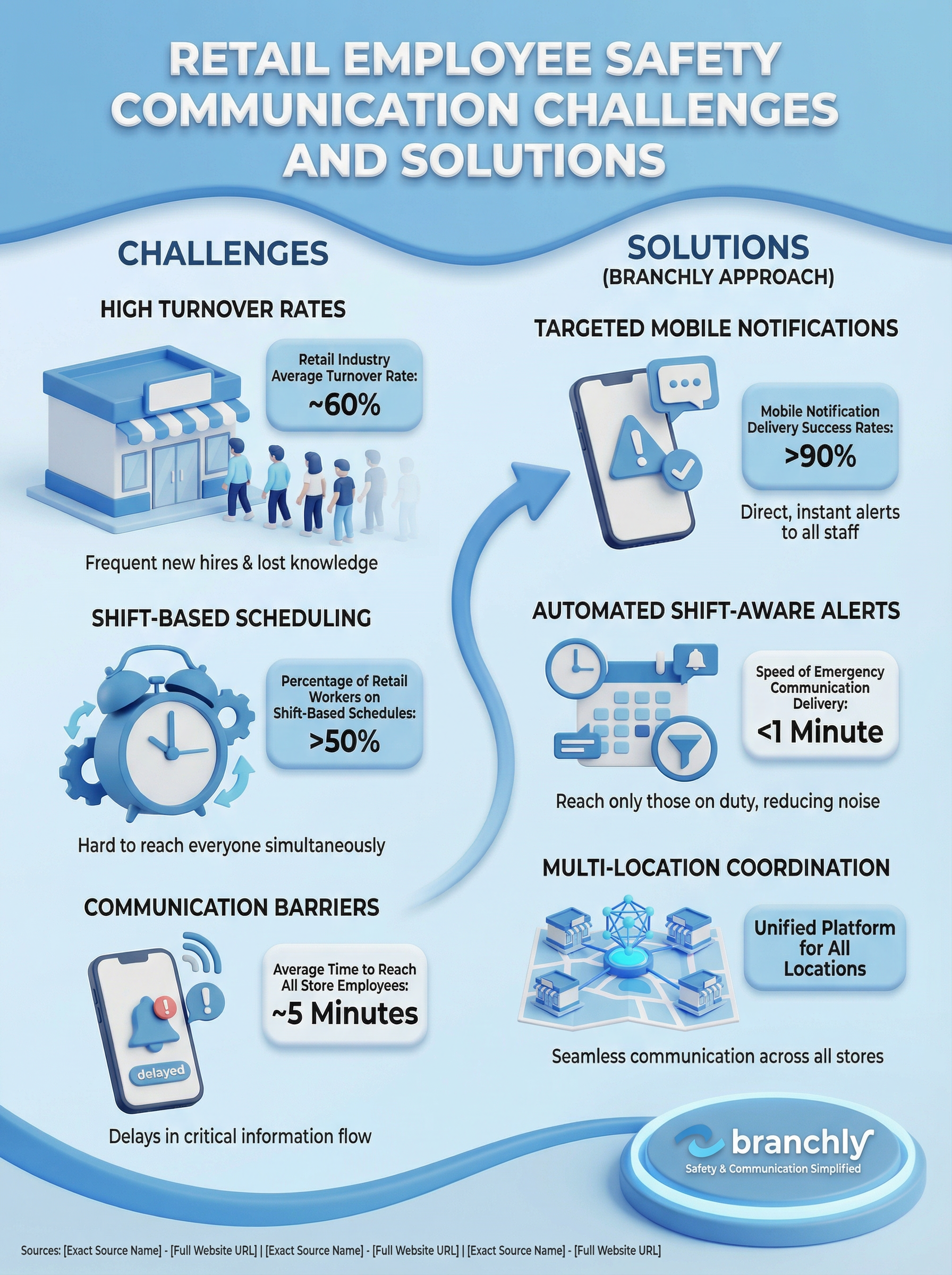
The retail industry leads all major employment sectors with voluntary turnover rates exceeding 21 percent, more than double the national average.
About 80 percent of retail workers are deskless, meaning they don't sit at computers during their shifts and can't check email regularly. These employees work rotating schedules that change weekly, swap shifts with coworkers, and often hold multiple part-time positions simultaneously. Traditional workplace communication tools built for office environments fail completely in retail settings. Yet regulatory requirements for workplace safety notifications continue to increase, with states like New York implementing specific retail worker safety mandates. The gap between communication expectations and reality puts both employees and organizations at risk during critical incidents.
The Retail Workforce Communication Challenge
Retail employment operates under conditions that make effective communication structurally difficult. The numbers tell a stark story. Canadian retail and wholesale industries maintain the highest voluntary turnover rate at 21.0 percent compared to the national average of 10.2 percent. American retail experiences comparable patterns, with some analyses placing turnover as high as 25.9 percent. This means that in a typical retail organization, more than one in five employees voluntarily leave each year. The practical implication: you're constantly communicating with people who are new to your organization, unfamiliar with your systems, and still learning basic procedures. When emergencies happen, these newest team members face the steepest learning curve precisely when speed matters most.
The causes behind retail turnover have been studied extensively. Low wages relative to cost of living, limited advancement opportunities, and irregular scheduling all contribute to employees seeking opportunities elsewhere. Merit increases in retail average only 2.8 percent annually, well below the 3.2 percent national average. But some retailers have proven that deliberate intervention can reverse these trends. Canadian Appliance Source implemented regionally adjusted compensation above market rates, internal mobility programs allowing employees to rotate through different departments, and systematic response to employee feedback gathered through annual surveys. The result: 53 employees reached five-year tenure milestones in a single year, an achievement previously considered impossible in retail environments.
Deskless Workers and Technology Access
Approximately 80 percent of the global retail workforce comprises deskless workers who perform their primary job functions away from stationary computers. These employees spend their shifts on sales floors, in stockrooms, at registers, or making deliveries. They don't check email during work hours because they don't have regular access to computers. They can't participate in video conferences scheduled during their shifts. Traditional office communication infrastructure simply doesn't reach them. This structural reality creates the foundational challenge for retail safety communication. Any notification system that assumes desktop access or email checking will fail to reach most of your workforce during the critical first minutes of an emergency.
Mobile devices offer the obvious solution, but implementation gets complicated. Not all retail employers provide work phones to frontline staff, meaning communication must reach personal devices. This introduces privacy concerns, device capability variations, and questions about who pays for data usage. Some employees work multiple retail jobs and carry multiple phones. Others share devices with family members. SMS text messaging works on any phone regardless of age or sophistication, operating on standard cellular networks without requiring internet connectivity or special applications. This universal accessibility makes SMS the most reliable channel for reaching retail workers during emergencies, achieving approximately 90 percent read rates within five minutes compared to 15 to 25 percent email open rates.
Shift Schedules and Temporal Fragmentation
Retail stores operate extended hours requiring shift-based staffing. A single location might run 16 hours daily with morning, afternoon, and evening shifts. Larger operations run 24 hours with night shifts added. This temporal distribution means your workforce is never assembled in one place at one time. An announcement made at 10 AM reaches morning shift workers during their workday, but reaches evening shift workers while they're sleeping or managing personal responsibilities. This temporal fragmentation makes traditional all-hands communication impossible. You can't gather everyone for a safety briefing because everyone is never present simultaneously. Fixed shifts assign consistent hours like permanent 7 AM to 3 PM positions. Rotating shifts cycle employees through different time periods according to predetermined schedules, distributing desirable and undesirable shifts fairly while maintaining coverage.
The complexity increases with rotating shift patterns. Continental shifts involve four teams working twelve-hour shifts in continuous rotation, cycling through morning, afternoon, night, and rest days. Panama shifts follow 2-2-3 rotations creating fourteen-day cycles with predictable patterns. Dupont shifts involve four-team rotations with four consecutive night shifts followed by three days off, then three consecutive day shifts with one day off. These sophisticated schedules optimize operational efficiency and workforce fairness, but they fragment employee populations into temporal cohorts that receive communications at different times through different channels. An employee working Tuesday morning this week might work Thursday evening next week, meaning any fixed communication schedule misaligns with actual work presence on a rotating basis.
Shift Swaps and Scheduling Complexity
Modern retail scheduling software enables shift swaps allowing workers to exchange assigned shifts with colleagues to accommodate personal needs. This flexibility improves employee satisfaction and reduces scheduling conflicts, but it introduces substantial complexity for emergency communication systems. A critical safety communication scheduled for Tuesday delivery may not reach an employee who swapped their Tuesday shift for a Thursday shift with a coworker, if your notification system associates messages with names rather than actual work presence. The problem compounds across large retail operations where hundreds of shift swaps occur weekly. Managed shift scheduling approaches where planners create schedules and confirm assignments, or self-service scheduling where employees select from available shifts, both generate detailed data about actual workforce distribution. Yet many retail organizations fail to integrate shift-swap data into their emergency communication systems, creating potential gaps between intended message recipients and employees actually present during incidents.
Turnover Impact
Retail turnover rates exceed 21 percent annually, meaning one in five employees is new each year. Emergency communication systems must account for constant workforce change and unfamiliarity with procedures.
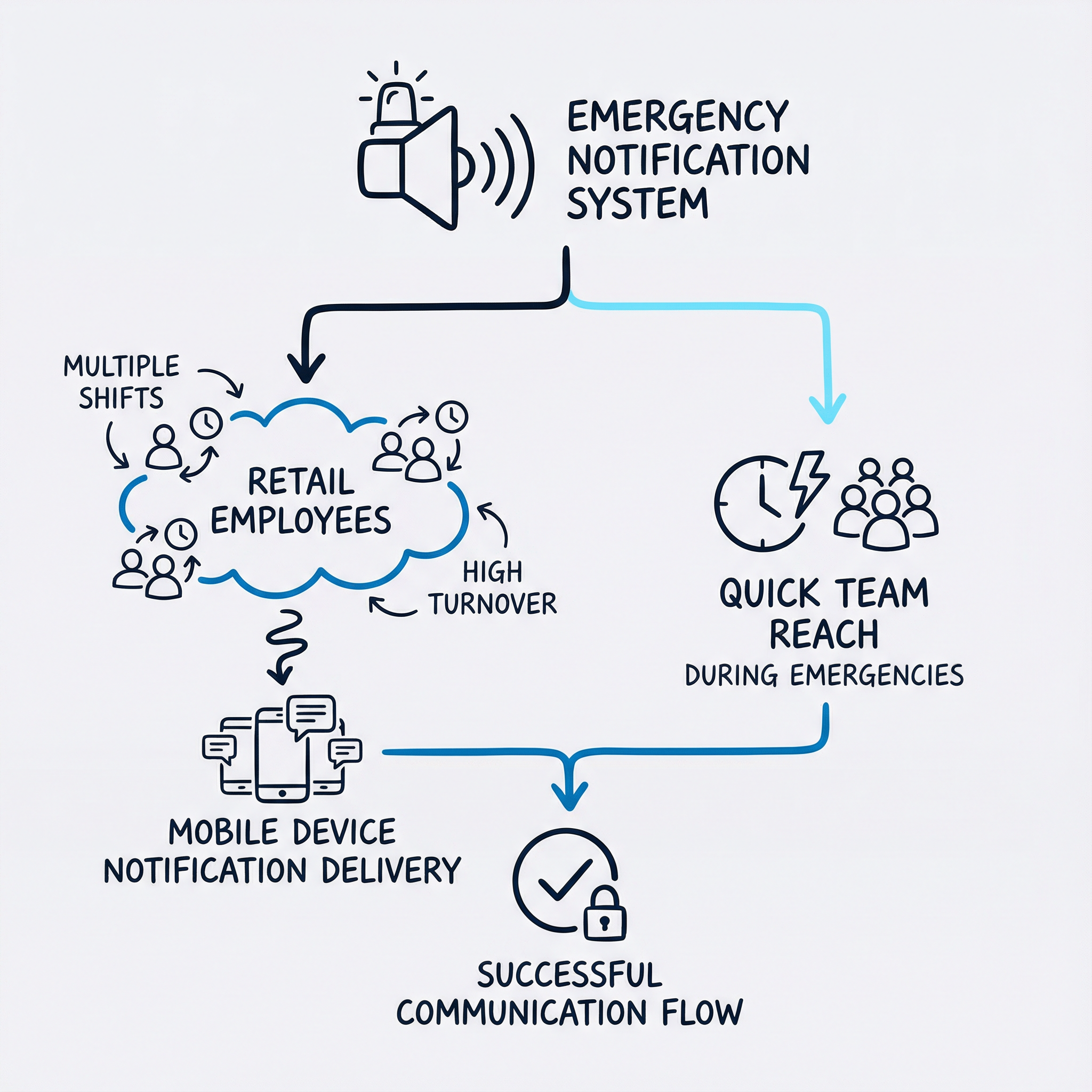
Text messages achieve 90 percent read rates within five minutes, compared to 15 to 25 percent email open rates.
Communication Channel Effectiveness in Retail
Different communication channels achieve dramatically different results in retail environments. Research on hourly retail worker engagement reveals that mobile-first approaches substantially outperform traditional methods dependent on desktop access. Text messaging and mobile application notifications prove far more effective than email or intranet systems requiring computer access. SMS notifications specifically demonstrate exceptional reach, with studies confirming that text messages achieve approximately 90 percent read rates within five minutes. Email open rates typically range between 15 and 25 percent, and many retail workers never check work email during shifts because they lack convenient access to computers. The effectiveness of SMS reflects fundamental accessibility factors. Text messaging functions on any mobile phone regardless of age or sophistication, eliminating barriers associated with smartphone requirements or mobile internet access.
SMS operates on standard cellular infrastructure available virtually everywhere, working reliably even in areas with poor network connectivity that might impair application-based communication. Text message delivery requires minimal data consumption, avoiding concerns about data plan costs or limits. These technical characteristics make SMS the most universally accessible communication channel for retail workforces spanning diverse age groups, technical skill levels, and device ownership patterns. In retail environments where employees bring personally owned devices to work, SMS operates independently of employer-provided technology. However, relying solely on a single channel creates vulnerability. Network outages, device failures, or individual circumstances can prevent message delivery through any single method. Building redundancy into notification systems ensures messages reach their intended recipients even when primary channels fail.
Multi-Channel Notification Strategies
Effective retail safety communication requires multi-channel approaches that reach employees through several paths simultaneously. Research on employee communication preferences reveals complexity beyond simple channel effectiveness. Workers desire receipt of specific information types through channels tailored for each message rather than uniform transmission across all platforms. Operational changes regarding process and policy updates rank among highest-priority information for retail employees, followed by organizational goals, people operations addressing benefits or development, culture and values communications, business updates, personnel announcements, competitive insights, and external events affecting operations. Different information types warrant different delivery methods optimized for urgency, detail level, and response requirements.
Emergency safety notifications demand immediate delivery through the fastest, most reliable channels available. SMS provides the foundation because of universal device compatibility and high read rates. Voice calls offer secondary confirmation for critical alerts, particularly for employees who might miss text messages. Mobile application push notifications work well for employees who have downloaded company apps, though this excludes workers without smartphones or those who haven't installed applications. Email serves as a documentation channel creating permanent records of notifications sent, even though retail workers may not check email promptly during shifts. Digital signage in break rooms and back-of-house areas reaches employees during natural breaks when they're away from customer-facing zones. In-store announcement systems provide immediate alerts to everyone present in a location during an incident.
Regulatory Requirements and Compliance Obligations
Workplace safety regulations increasingly mandate specific notification requirements for retail environments. OSHA requires employers to post notices informing employees of their rights and employer responsibilities under occupational safety and health laws. These posting requirements create baseline communication obligations, but they represent minimum compliance rather than effective emergency notification. State-level regulations often exceed federal requirements. New York's Retail Worker Safety Act requires employers with ten or more retail employees to distribute specific safety policies and provide training, with frequency varying by employee category.
Washington State updated regulations in 2024 to extend panic button requirements to healthcare facilities, building on prior rules establishing notification expectations for threatened workers.
OSHA's February 2024 Notice of Proposed Rulemaking for Emergency Response Standards seeks to ensure emergency responders receive appropriate protections, with implications for how organizations communicate during incidents. The proposed rules emphasize the importance of clear communication protocols and documented notification procedures. Compliance verification increasingly requires proof that safety communications actually reached intended recipients, not just evidence that messages were sent. Audit trails documenting message delivery, read receipts, and employee acknowledgment become critical for demonstrating regulatory compliance. Organizations that cannot prove employees received and understood safety notifications face substantial liability during incident investigations. The shift from aspirational communication to documented delivery creates new technical requirements for notification systems.
Documentation and Audit Requirements
Regulatory compliance in retail safety communication requires comprehensive documentation of notification attempts, successful deliveries, and employee responses. Manual systems using phone trees or email lists struggle to provide the detailed records needed for audit defense. Who received messages? When did they read them? Did they acknowledge understanding? Which employees were working specific shifts when incidents occurred? These questions become critical during regulatory investigations or legal proceedings following workplace incidents. Modern notification systems must capture and store detailed metadata about every communication, including timestamp of message creation, list of intended recipients, delivery confirmation for each recipient, read receipts where available, employee acknowledgment responses, and failed delivery attempts with reasons.
This documentation serves multiple purposes beyond regulatory compliance. It helps organizations identify communication gaps and system weaknesses. Analysis of delivery failures reveals employees with outdated contact information, devices incompatible with notification systems, or individuals who consistently fail to respond to alerts. This data enables proactive improvement of notification systems before emergencies occur. Documentation also protects organizations from liability claims alleging inadequate warning or insufficient safety communication. When organizations can demonstrate that appropriate notifications were sent through multiple channels to all affected employees, with confirmation of receipt, they substantially reduce legal exposure following incidents. The documentation itself becomes evidence of due diligence and reasonable care for employee safety.
SMS Effectiveness
Text messages achieve 90 percent read rates within five minutes, compared to 15 to 25 percent email open rates. SMS works on any phone without internet access, making it the most reliable retail notification channel.
Real-World Emergency Scenarios in Retail
Retail environments face distinct emergency scenarios requiring rapid communication to protect employees and customers. Active shooter events represent the most severe threat, with retail locations among the most common targets for such incidents. Research on active shooter response emphasizes that communication speed directly affects survival outcomes. Employees need immediate notification of threats, clear instructions for response actions, and updates as situations evolve. Traditional communication methods fail completely in active shooter scenarios because they're too slow. By the time a phone tree reaches the tenth person, the situation has already escalated. SMS alerts can reach hundreds of employees simultaneously within seconds, providing the immediate awareness that saves lives. Medical emergencies occur regularly in retail settings with hundreds of daily customers. Employees need to know how to summon help, where emergency equipment is located, and what actions to take while waiting for professional responders.
Weather events affect retail operations across all geographic regions. Severe storms, tornadoes, hurricanes, flooding, extreme heat, and winter weather all create safety threats requiring employee notification and response. Weather emergencies often develop rapidly with little warning time. Notification systems must reach employees quickly enough for them to take protective action before conditions become dangerous. The challenge intensifies for multi-location retail operations where different stores face different weather conditions simultaneously. A retailer with 50 locations across a region might need to send evacuation alerts to 12 stores in a tornado warning area while sending shelter-in-place instructions to 8 stores experiencing severe thunderstorms and all-clear messages to 30 stores outside affected zones. Manual communication systems cannot handle this complexity at the speed required for effective response.
Equipment Failures and System Outages
Point-of-sale system failures, network outages, and equipment breakdowns create operational emergencies requiring immediate employee notification. When payment systems go down, employees need to know whether to continue serving customers with manual processing, whether to close the store temporarily, or how to handle the situation. Without clear communication, different employees make different decisions, creating inconsistent customer experiences and potential security vulnerabilities. Power outages present particular challenges because they disable many communication tools simultaneously. If your notification system depends on in-store computers or internet connectivity, power failures prevent you from reaching employees precisely when they most need guidance. SMS notifications sent from cloud-based systems reach employees even during complete facility power loss because they rely on cellular networks with independent power sources and mobile devices employees carry with them.
HVAC failures create urgent situations in retail environments, particularly in extreme weather. Summer heat combined with failed air conditioning creates dangerous conditions for employees and customers within hours. Winter heating failures pose similar risks in cold climates. Elevator breakdowns trap customers or employees, requiring immediate response from trained personnel. Fire alarm activations demand coordinated evacuation following specific procedures. Each scenario requires rapid communication of specific information to the right people. Generic alert systems that blast the same message to everyone prove ineffective because different employees need different information based on their roles and locations. Effective notification systems target messages to specific employee groups with information relevant to their responsibilities during each type of incident.
Staffing Emergencies and Operational Disruptions
Retail operations depend on adequate staffing to maintain service levels and safety. Sudden staffing shortages when multiple employees call out sick, fail to appear for shifts, or leave during shifts create operational emergencies requiring immediate communication to backup personnel. Traditional approaches involve managers manually calling through lists of off-duty employees, hoping to reach someone willing to work extra hours. This process wastes valuable time and often fails to fill positions quickly enough. Notification systems that can instantly alert all qualified backup personnel simultaneously, then track responses and confirm coverage, resolve staffing emergencies faster and more reliably. The same capabilities help manage planned staffing changes during unexpected busy periods when stores need additional coverage.
Security incidents including theft, vandalism, or threatening customer behavior require immediate communication to security personnel and management. Employees need to know when police have been called, where to direct customers during security incidents, and what actions to avoid that might escalate situations. Supply chain disruptions that prevent expected deliveries affect store operations and require employee notification about product availability, customer communication, and alternative procedures. Each of these scenarios demonstrates why effective retail safety communication requires more than blast messages sent to everyone. Different situations demand different information delivered to specific employee groups at precise times. The complexity exceeds what manual systems can handle reliably under pressure.
Pre-Approved Templates
Emergency message templates pre-approved by legal and operations teams enable managers to send complete, accurate notifications in seconds rather than composing messages during high-stress incidents.
Building Effective Retail Notification Systems
Effective retail employee safety communication starts with accurate, current contact information for every employee. This sounds obvious, but many retail organizations struggle with contact data quality. High turnover means constant onboarding of new employees who must provide contact information. Shift swaps and schedule changes mean different employees work different days. Phone numbers change as employees switch carriers or get new devices. Email addresses become outdated when employees leave previous jobs. The challenge intensifies in retail operations where many employees work part-time, hold multiple jobs, or experience housing instability affecting their contact information. Manual spreadsheets and disconnected systems cannot maintain current contact data across hundreds of employees. Integration with HR systems that automatically update contact information when employees make changes solves this foundational problem. When an employee updates their phone number in the HR portal, that change should automatically flow to the emergency notification system without manual data entry or file imports.
Contact data quality requires ongoing verification, not one-time collection. Periodic test messages confirm that stored phone numbers and email addresses still work. Response tracking identifies employees who never respond to notifications, indicating potential contact data problems or communication barriers. Some employees may lack reliable mobile service, use phones shared with family members, or have devices incompatible with certain message formats. Identifying these situations before emergencies occur allows proactive problem-solving. Alternative contact methods, updated device information, or additional communication channels can be arranged when issues are discovered through routine testing rather than during actual incidents. Organizations should verify contact data monthly for all employees and immediately upon hire for new team members.
Message Templates and Pre-Approved Content
Emergency communication must be both fast and accurate. Speed matters because delayed warnings reduce response time and increase danger. Accuracy matters because incorrect information causes confusion and inappropriate actions. These requirements conflict when managers must compose messages from scratch during high-stress situations. Writing clear, complete, accurate instructions while managing an unfolding emergency exceeds most people's capabilities. Pre-approved message templates solve this problem by providing tested, verified communication ready for immediate use. Templates should cover every foreseeable emergency scenario your retail operations might face. Active threat alerts with instructions for lockdown procedures. Weather warnings with shelter locations and safety actions. Evacuation orders with exit routes and assembly points. All-clear notifications confirming that danger has passed. Equipment failure alerts with workaround procedures.
Medical emergency notifications with responder locations. Templates should be customized for each location because specific instructions vary by building layout, local procedures, and available resources. The template for a weather shelter alert should include the actual shelter location for each store, not generic instructions requiring managers to fill in details during emergencies. Pre-approval by legal and compliance teams ensures templates meet regulatory requirements and minimize liability exposure. Review by operations leadership confirms that instructions match actual procedures and available resources. Testing with employee focus groups verifies that messages are clear and understandable to your workforce. This upfront investment in template development pays substantial dividends during actual incidents when managers can send complete, accurate notifications in seconds rather than minutes.
Role-Based Notification and Targeted Messaging
Segmentation by Role and Responsibility
Not every employee needs the same information during emergencies. Store managers require different notifications than sales associates. Security personnel need different alerts than cashiers. Maintenance staff must receive different instructions than customer service representatives. Sending identical messages to everyone creates several problems. Employees receive irrelevant information diluting the importance of communications. Critical instructions for specific roles get buried in messages containing mostly inapplicable content. Message volume increases unnecessarily, contributing to alert fatigue where employees stop paying attention because most notifications don't apply to them. Role-based notification systems solve these problems by targeting messages to specific employee groups based on their responsibilities during different emergency scenarios.
Store managers receive high-level situation updates, coordination instructions, and decision-making authority information. Department supervisors get tactical instructions for their areas of responsibility. Frontline employees receive specific action items relevant to their positions. This segmentation ensures everyone gets exactly the information they need without irrelevant content. Implementation requires maintaining accurate role assignments in your notification system. Integration with HR systems that track employee positions, responsibilities, and locations enables automatic role-based targeting. When a manager sends an alert about an equipment failure, the system automatically determines which maintenance personnel should receive detailed technical instructions, which supervisors need operational workarounds, and which frontline employees require customer communication guidance.
Location-Based Targeting and Geographic Specificity
Multi-location retail operations need location-specific notification capabilities. A weather emergency affecting stores in one region should not trigger alerts for employees hundreds of miles away working in unaffected locations. A power outage at Store 47 requires notifications to employees working that shift at that location, not to everyone across your entire organization. Location-based targeting prevents alert fatigue by ensuring employees only receive notifications relevant to their current work location. This requires systems that track employee work locations in real-time, not just home store assignments. With shift swaps and employees who work multiple locations, knowing where someone is assigned isn't enough. You need to know where they're actually working right now. Integration with point-of-sale systems, time clock data, or shift scheduling platforms provides this real-time location information.
Geographic targeting also enables proactive communication about emerging situations. When severe weather is forecast for specific regions, you can alert employees scheduled to work affected locations about potential schedule changes, closure decisions, or safety procedures. This advance notice helps employees plan appropriately rather than being surprised by last-minute changes. Similarly, local incidents like nearby accidents affecting traffic, area power outages, or community events impacting store access warrant notifications to affected locations only. The combination of role-based and location-based targeting creates highly specific communication reaching exactly the right people with exactly the right information at exactly the right time. This precision maximizes notification effectiveness while minimizing unnecessary alerts that contribute to message fatigue.
Testing and Training for Notification Readiness
The best notification system in the world fails if employees don't know how to respond to alerts or if technical problems prevent message delivery. Regular testing identifies these issues before real emergencies occur. Testing serves multiple purposes: verifying that technical systems work correctly, confirming that contact data is current and accurate, ensuring employees recognize and respond appropriately to alerts, identifying gaps in procedures or communication content, and meeting regulatory requirements for emergency preparedness. Testing should occur at multiple levels with varying frequency. Technical system tests verifying that the notification platform can send messages and track delivery should happen weekly through automated processes. These tests confirm infrastructure health without requiring employee participation. Contact data verification tests sending actual test messages to employees should occur monthly to identify outdated phone numbers or email addresses before they cause problems during emergencies.
Full-scale emergency communication drills simulating actual incident scenarios should happen quarterly. These comprehensive tests evaluate the entire communication process from situation assessment through notification delivery to employee response. Drills might simulate a severe weather event requiring shelter-in-place procedures, an equipment failure requiring operational workarounds, or a security incident requiring partial evacuation. Employees should respond to drill notifications as they would during real emergencies, following procedures and confirming receipt. Analysis of drill results reveals weaknesses in communication speed, message clarity, employee understanding, or response coordination. Organizations should treat drill findings as opportunities for improvement rather than compliance exercises. Each drill should generate specific action items addressing identified gaps.
Employee Training and Response Expectations
Notification systems only work when employees understand how to respond to alerts. Training must address several key areas: recognizing emergency notifications and distinguishing them from routine communications, understanding the meaning of different alert types and urgency levels, knowing what actions to take in response to various emergency scenarios, using confirmation features to acknowledge receipt and report status, and finding additional information or asking questions during incidents. New employee orientation should include emergency communication training covering these topics before employees work their first shift. Waiting weeks or months to train new hires means they're unprepared if emergencies occur during their initial employment period. Given retail's high turnover, substantial portions of your workforce may be relatively new at any given time.
Ongoing refresher training ensures employees remember emergency procedures and stay current with system changes. Annual training sessions reviewing emergency communication processes, common scenarios, and updated procedures keep preparedness top of mind. Brief reminders during regular team meetings maintain awareness without requiring lengthy training sessions. Training should be role-specific, covering the particular responsibilities and actions relevant to each position. Store managers need training on initiating notifications, coordinating response, and communicating with authorities. Supervisors need training on implementing protective actions and accounting for their team members. Frontline employees need training on personal safety actions and customer assistance procedures. This targeted approach ensures training time focuses on information directly applicable to each employee's responsibilities.
Measuring Communication Effectiveness
Organizations should track metrics demonstrating notification system performance and identifying improvement opportunities. Key performance indicators for retail emergency communication include message delivery time measuring seconds from initiation to delivery, delivery success rate showing percentage of intended recipients who received messages, read rates indicating how many recipients opened messages, response rates tracking employee acknowledgment, time to full employee accounting measuring how long until all affected employees are confirmed safe, and employee feedback scores from post-incident surveys. These metrics provide objective data about system effectiveness. Delivery times below 60 seconds for 95 percent of recipients represent strong performance. Read rates above 80 percent within five minutes indicate effective channel selection. Response rates above 70 percent for acknowledgment requests show good employee training.
Analysis of metrics over time reveals trends requiring attention. Declining read rates might indicate alert fatigue from too many non-emergency notifications. Increasing delivery failures might signal growing contact data quality problems. Variation in response rates between locations might reveal training gaps or management inconsistency. Regular review of these metrics, ideally monthly, enables proactive system improvement before performance degrades significantly. Organizations should establish target performance levels for each metric and investigate when actual performance falls below targets. Root cause analysis determines why performance suffered and what corrective actions will prevent recurrence. This disciplined approach to measurement and improvement ensures notification systems maintain effectiveness despite workforce changes, operational evolution, and growing scale.
Summary
Retail employee safety communication faces unique challenges from high turnover, shift-based scheduling, and deskless workforce characteristics. Traditional communication methods built for office environments fail in retail settings where employees lack regular computer access and work rotating schedules across multiple locations. Effective notification requires mobile-first approaches using SMS as the foundation, supplemented by voice calls, application alerts, and in-store systems for redundancy. Pre-approved message templates enable rapid, accurate communication during high-stress incidents. Role-based and location-based targeting ensures employees receive relevant information without alert fatigue from irrelevant messages.
Implementation success depends on accurate contact data maintained through HR system integration, regular testing verifying technical functionality and employee preparedness, comprehensive training for new hires and ongoing refreshers, and measurement of notification performance through delivery time, read rates, and response metrics. Organizations that invest in purpose-built retail notification systems protect employees more effectively, demonstrate regulatory compliance through documented delivery confirmation, and respond to emergencies with speed and coordination impossible through manual methods. The gap between communication expectations and reality puts both employees and organizations at risk. Closing that gap requires tools designed specifically for retail's unique operational environment.
Key Things to Remember
- ✓Retail turnover exceeds 21 percent annually with 80 percent of workers deskless, creating communication challenges that traditional office-focused tools cannot solve effectively.
- ✓SMS achieves 90 percent read rates within five minutes compared to 15-25 percent for email, making text messaging the most reliable retail notification channel.
- ✓Pre-approved message templates enable managers to send complete, accurate emergency notifications in seconds rather than composing messages during high-stress incidents.
- ✓Role-based and location-based targeting ensures employees receive only relevant notifications, preventing alert fatigue while maintaining rapid response capabilities.
How Branchly Can Help
Branchly provides retail organizations with notification systems designed specifically for high-turnover, multi-location operations. The platform integrates with HR and scheduling systems to maintain current contact data and real-time location information, ensuring messages reach the right employees regardless of shift swaps or schedule changes. Pre-approved message templates covering every emergency scenario enable managers to send complete, accurate notifications in seconds. Role-based and location-based targeting delivers relevant information to specific employee groups without overwhelming your workforce with irrelevant alerts. SMS delivery combined with voice, email, and application notifications creates redundancy ensuring message delivery even during network problems. Automated testing verifies contact data accuracy monthly while comprehensive audit trails document delivery confirmation for regulatory compliance. The platform tracks delivery time, read rates, and response metrics, providing objective data about notification effectiveness and identifying improvement opportunities before real emergencies test your systems.
Citations & References
- [1]
- [2]
- [3]
- [4]
- [5]
- [6]
- [7]
- [8]
- [9]
- [10]
- [11]
- [12]