
Introduction
The system goes down at 9:47 a.m. Your customers start showing up at 9:51. By 10:00, your front desk is fielding questions no one prepared them to answer. One employee says the outage will be fixed in an hour. Another blames the vendor. A third just shrugs and says they don't know anything.
This is the reality of crisis communication for multi-location organizations. Your frontline staff become your de facto spokespeople whether you planned for it or not. They're the ones standing in front of frustrated customers, confused vendors, and worried employees when things break. But most organizations focus crisis communication training on leadership and PR teams, leaving the people who need it most unprepared. The result: mixed messages, damaged trust, and customers who walk away wondering if anyone at your organization knows what's happening. Training your frontline teams to communicate clearly and consistently during disruptions isn't optional. It's the difference between a crisis that gets managed and one that spirals.
Why Frontline Communication Breaks Down in Crises
Most communication failures start with a simple problem: your frontline staff don't know what they're allowed to say. They haven't seen approved talking points. No one told them who to escalate questions to. And they're making split-second decisions about what to tell customers while also trying to figure out what's happening themselves.
This isn't a failure of intelligence or effort. It's a failure of preparation. Organizations with multiple locations face a coordination problem that single-site businesses don't: every location becomes an independent source of information during a crisis. Without consistent training and pre-approved messaging, each site drifts toward its own version of the truth. One manager hears something on a conference call and passes it along to their team. Another location hears nothing and fills the gap with guesses. A third gets partial information and improvises the rest.
The Information Vacuum Problem
Crises create information vacuums. Your leadership team is scrambling to understand what happened, assess the impact, and coordinate response. That process takes time. But customers and employees need answers now. So frontline staff fill the vacuum with whatever information they have, accurate or not.
The problem compounds across locations. A hotel front desk agent tells a guest the booking system will be back online in 30 minutes because that's what they were told during a previous outage. A bank teller says customer accounts are secure because they assume that's always true. A retail associate promises a refund because that seems like the right thing to do, not realizing the payment system can't process refunds until the crisis resolves.
When Staff Become Unofficial Spokespeople
Your communications team might draft perfect statements for media inquiries. Your executives might approve carefully worded customer emails. But none of that matters if your frontline staff are telling a different story to the people standing in front of them.
Customers judge your organization based on what they hear first, and they usually hear it from frontline staff. If that first message is inconsistent with what they hear later from official channels, trust erodes. If different locations give different answers, your brand looks disorganized. And if staff seem unprepared or uninformed, customers wonder whether anyone is actually managing the crisis.
High Turnover Makes Training Harder
Many multi-location organizations deal with high turnover in customer-facing roles. Hotels, restaurants, retail stores, and branches with seasonal staff face constant churn. That makes consistent crisis communication training nearly impossible using traditional methods. By the time you train everyone, half the team has turned over and new hires haven't been through the program yet. The result: some staff know what to do during a crisis, and others are winging it.

Customer Communication Training for Frontline Staff During Crises
What Frontline Staff Actually Need to Know
Effective crisis communication training for frontline staff isn't about memorizing scripts. It's about giving people a framework for handling uncertainty. They need to know what they can say, what they shouldn't say, and who to ask when they're not sure. They need confidence that comes from practice, not just from reading a policy once during onboarding.
The Core Message: Acknowledge, Reassure, Escalate
Start with a simple three-part structure that works for almost any crisis scenario. First, acknowledge what's happening. Don't pretend everything is fine when it clearly isn't. Customers lose trust when staff deny obvious problems. A simple acknowledgment validates their concern and shows you're aware of the issue.
Second, offer reasonable reassurance without making promises you can't keep. Frontline staff should never promise specific timelines unless they've been authorized to do so. But they can say things like 'Our team is working on this' or 'We're getting updates regularly.' That's honest, accurate, and doesn't create expectations you might not meet.
Third, know when to escalate. Some questions need management input. Some situations require a supervisor's authority. Teach staff to recognize when they've reached the edge of their knowledge or authority and to bring in someone who can help. That's not a failure. It's smart crisis management.
Script the First Sentence
Give staff a specific opening line for common crisis scenarios. 'We're experiencing a system outage that's affecting service right now' is better than leaving people to improvise under pressure.
What Not to Say: The Red Lines
Just as important as knowing what to say is knowing what not to say. Train staff to avoid speculation about causes, timelines, or blame. 'I think it's the vendor's fault' might be true, but it's not something a frontline employee should say to a customer. Same with specific time estimates unless they've been officially communicated.
Don't minimize customer impact. Saying 'It's not that bad' or 'It could be worse' dismisses legitimate frustration. Instead, acknowledge the inconvenience and focus on what you're doing to address it. And never share information about other customers, other locations, or internal systems that customers shouldn't know about. Crises make people chatty, and staff might overshare without realizing the implications.
Pre-Approved Talking Points for Common Scenarios
Generic training only goes so far. Staff need specific language for the crises most likely to affect your organization. If you're a hotel chain, what do staff say when the booking system crashes? If you're a bank, what's the approved message during a technology outage that affects ATMs and online banking? If you're a franchise network, how do owners communicate supply chain disruptions to customers?
Pre-approved talking points give staff confidence and consistency. They know they're saying something that's been vetted by leadership. They're not improvising or guessing. And when every location uses the same core messaging, customers get a consistent experience no matter which site they interact with.
Building Training That Actually Sticks
The worst crisis communication training is the kind people complete once, forget about, and never reference again. You need training that sticks because the next crisis won't announce itself in advance. Your staff need to remember what to do when the pressure hits.
Role-Playing Beats Reading
People remember what they practice, not what they read. Role-playing exercises let staff practice delivering crisis messages in a low-stakes environment. Pair them up and run through scenarios: one person plays an upset customer, the other practices using approved talking points. Switch roles. Try different crisis types. Make it conversational, not theatrical.
This works particularly well during team meetings or pre-shift huddles. It takes ten minutes and gives people muscle memory for crisis communication. When the real thing happens, they've already said the words out loud before. That familiarity reduces panic and improves performance.
Quick Reference Cards for the Moment of Need
No one remembers everything under pressure. Give staff laminated quick reference cards they can keep at their workstation. One side has the three-part structure. The other side has talking points for your top three crisis scenarios. Simple, visual, and accessible when they need it most. Digital versions work too if staff have tablets or can access a shared document quickly. The key is making the information findable in seconds, not buried in a policy manual they'd have to search through while a customer is standing there waiting.
Coordinating Messaging Across Multiple Locations
Single-location businesses have it easier. Train one team, deliver one message, manage one response. Multi-location organizations need to coordinate across sites that might be dealing with different impacts from the same crisis. A technology outage might take down some locations completely while others operate with limited functionality. A supply chain disruption might hit one region harder than another. Your communication strategy needs to account for that complexity.
Centralized Message Creation, Local Delivery
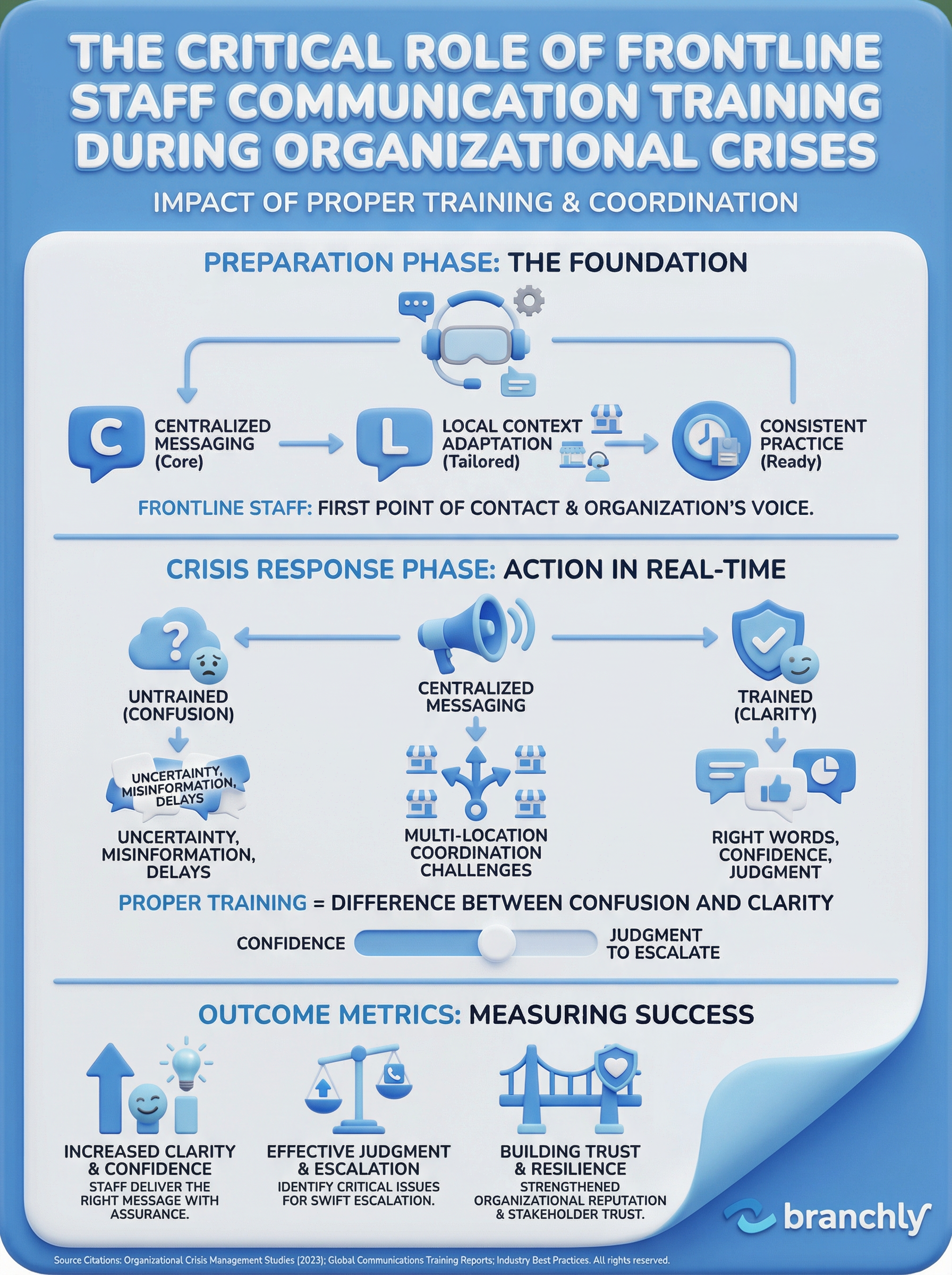
The best approach centralizes message creation while allowing for local delivery. Your communications team or crisis leadership develops core talking points that apply organization-wide. Those get pushed to all locations simultaneously, so everyone starts with the same information. But local managers have the authority to add context specific to their site. Maybe one location can still process credit cards manually while others can't. Maybe one branch has longer wait times than others. Local context matters, but it should supplement core messaging, not replace it.
This requires clear protocols. Who creates the core message? How fast does it need to reach all locations? What channel do you use to distribute it? Email works if people are checking regularly, but during a crisis, they might not be. Text messages or a dedicated crisis communication platform get information to staff faster and with confirmation they received it.
Real-Time Updates Without Chaos
Crises evolve. The message you give staff at 10 a.m. might be outdated by noon. You need a way to update messaging in real time without creating confusion. That means establishing a clear update cadence. Maybe you commit to sending new information every hour, even if the update is just 'no change yet.' Predictable timing helps staff know when to expect new information and reduces the urge to fill gaps with speculation.
Also important: version control. If you send out updated talking points, make it obvious they're replacing the previous version. Number them. Timestamp them. Make it impossible for staff to accidentally use old messaging because they didn't realize a new version came through. In multi-location organizations, version confusion is one of the most common reasons for inconsistent customer communication during crises.
Industry-Specific Communication Challenges
Different industries face different frontline communication challenges during crises. What works for a hotel chain won't work the same way for a credit union. Tailoring your training to your specific operational context makes it more useful and more likely to be remembered when it matters.
Financial Services: Balancing Transparency and Security
Bank and credit union staff face unique pressure during crises. Customers want to know their money is safe, and they want to know it immediately. Frontline staff need training that addresses security concerns without creating panic. They should be able to confidently say that customer accounts are protected without getting into technical details they're not qualified to explain.
Regulatory compliance adds another layer. Staff need to understand what they're legally allowed to disclose and what has to go through official channels. A teller can acknowledge a system outage. They can't speculate about whether customer data was compromised. Training needs to draw those lines clearly so staff don't accidentally say something that creates legal or regulatory problems later.
Hospitality: Managing Guest Experience Under Pressure
Hotel staff deal with guests who are often away from home, already stressed, and expecting a certain level of service. When elevators break, when air conditioning fails, when the Wi-Fi goes down, guests want immediate solutions. Frontline staff need to balance empathy with realistic expectations. They can offer workarounds when possible. They can escalate to managers who have authority to comp services or relocate guests. But they need to know what they can promise and what requires approval.
High turnover in hospitality makes training consistency hard. Your best approach: integrate crisis communication into new hire onboarding and reinforce it through regular team meetings. Make it part of the culture, not a one-time training event people forget about.
Franchise Networks: Standardizing the Unstandardizable
Franchises face a coordination challenge that corporate-owned locations don't. Each franchise owner operates independently, hires their own staff, and manages their own training programs. That makes it hard to ensure consistent crisis communication across the network. But brand reputation depends on it. When one franchise handles a crisis poorly, it affects customer perception of the entire brand.
Franchisors need to provide standardized training materials that are easy for owners to implement. Video modules work well. So do simple training guides that walk through common scenarios. The key is making it low-effort for franchise owners to train their teams while maintaining brand consistency in crisis messaging.
Testing Your Training Before a Real Crisis Hits
Training only matters if it works when you need it. That means testing it before a real crisis forces you to find out the hard way. Crisis exercises aren't just for executives and emergency response teams. Frontline staff need to participate too.
Tabletop Exercises with Customer Interaction Scenarios
A tabletop exercise walks your team through a crisis scenario without the pressure of a real event. You present a situation: the payment system is down, customers are asking questions, what do you say? Staff practice using approved talking points. Managers practice escalating decisions. Everyone gets to see how information flows from leadership to frontline and back up again.
Include customer interaction scenarios specifically. Don't just focus on internal coordination. Have someone play an upset customer and see how well staff apply their training. What do they say first? Do they use approved language? Do they know when to escalate? The gaps you find during exercises are gaps you can fix before they matter.
Mystery Shopper-Style Spot Checks
After initial training, test retention through unannounced spot checks. Send someone to a location posing as a customer with a crisis-related question. How does the staff member respond? Do they remember their training? Do they escalate appropriately? This isn't about catching people doing something wrong. It's about identifying where additional training or support is needed. If most staff handle it well, your training is working. If they don't, you know where to focus your next round of reinforcement.
Sustaining Training Over Time
One training session isn't enough. People forget. New scenarios emerge. Staff turnover means you're constantly onboarding new team members who haven't been through crisis communication training yet. Sustaining training over time requires building it into your regular operations, not treating it as a once-and-done event.
Quarterly Refreshers Keep Skills Sharp
Schedule brief refresher training every quarter. Ten to fifteen minutes is enough. Review core talking points. Walk through any new crisis scenarios that have emerged. Share lessons from recent exercises or actual incidents. Make it conversational, not formal. The goal is keeping crisis communication top of mind without overwhelming people with another mandatory training requirement.
You can also integrate crisis communication into regular team meetings. Take five minutes to role-play a scenario. Ask staff what they'd say if a customer asked about a hypothetical outage. This keeps the training fresh and gives people ongoing practice without requiring dedicated training sessions.
After-Action Reviews Build on Real Experience
Every time you activate your crisis response, conduct an after-action review that includes frontline staff. What messages did they deliver to customers? What worked? What confused people? What questions did they get that they weren't prepared to answer? That feedback informs your next round of training and helps you refine talking points based on real-world performance.
This creates a continuous improvement loop. Training informs crisis response. Crisis response reveals training gaps. Those gaps get addressed in the next training cycle. Over time, your frontline communication gets better and better because you're learning from actual experience, not just theoretical scenarios.
Making Training Part of Your Culture
The organizations that do crisis communication best treat it as part of their operational culture, not a compliance checkbox. New hires learn crisis messaging during onboarding. Managers reinforce it in team meetings. Quick reference materials are visible at every workstation. When a crisis happens, staff feel prepared because preparedness is woven into how they work.
Leadership sets the tone for that culture. When executives emphasize the importance of consistent customer communication, staff take it seriously. When crisis communication training is treated as optional or an afterthought, it shows. Your frontline teams will rise to the level of preparation you set for them. Make that level high enough to matter.
Summary
Frontline staff become your organization's voice during crises whether you prepare them or not. The difference between confusion and clarity comes down to training that gives people the words to say, the confidence to say them, and the judgment to know when they need help. Multi-location organizations face unique coordination challenges, but the principles stay the same: centralized messaging, local context, and consistent practice.
Training isn't a one-time event. It's an ongoing process that evolves as your organization learns from exercises and real incidents. The organizations that handle customer communication best during crises are the ones that made it part of their culture long before the crisis arrived.
Key Things to Remember
- ✓Frontline staff become unofficial spokespeople during crises. Without training, they fill information vacuums with speculation and inconsistent messaging.
- ✓The three-part crisis communication structure works for most scenarios: acknowledge the situation, offer reasonable reassurance, and know when to escalate.
- ✓Pre-approved talking points for common crisis scenarios give staff confidence and ensure consistent messaging across all locations.
- ✓Role-playing exercises and quick reference cards create muscle memory that helps staff perform under pressure when real crises hit.
- ✓Crisis communication training needs ongoing reinforcement through quarterly refreshers, after-action reviews, and integration into daily operations.
How Branchly Can Help
Branchly's pre-approved communication templates eliminate the guesswork for frontline staff during crises. Our platform generates scenario-specific messaging that's been vetted by your leadership team and can be deployed to all locations instantly. Staff access talking points through mobile devices or workstation dashboards, ensuring they always have the right words when customers ask tough questions. Real-time updates push new messaging as situations evolve, with clear version control so everyone knows they're using current information. After each crisis activation, Branchly's intelligence layer analyzes which messages worked, which confused people, and where additional training would help, creating a continuous improvement loop that makes your frontline communication stronger with every incident.
Citations & References
- [1]
- [2]
- [3]Key Resilience and Business Continuity Indicators for Financial Institutions ncontracts.com View source ↗
- [4]
- [5]Making the Case for ROI-Enhancing Business Continuity Management Software Capabilities thebci.org View source ↗
- [6]Three Key Components of Creating a Business Continuity Strategy insights-north-america.aon.com View source ↗
- [7]